Carson Group
Carson Group
Discovery Case Study
Discovery Case Study
Download Full Case Study
This is the web view, a trimmed down version that hits all the key points of the Carson Group Discovery without overwhelming you with details. Want the full story? Feel free to download the complete PDF case study for all the details and insights! It's perfect when you need the comprehensive picture of this exciting project.
This web view provides a concise overview of the GoFar Rewards project. For the complete case study with detailed insights, download the PDF version.
Download PDF
Overview & Problem
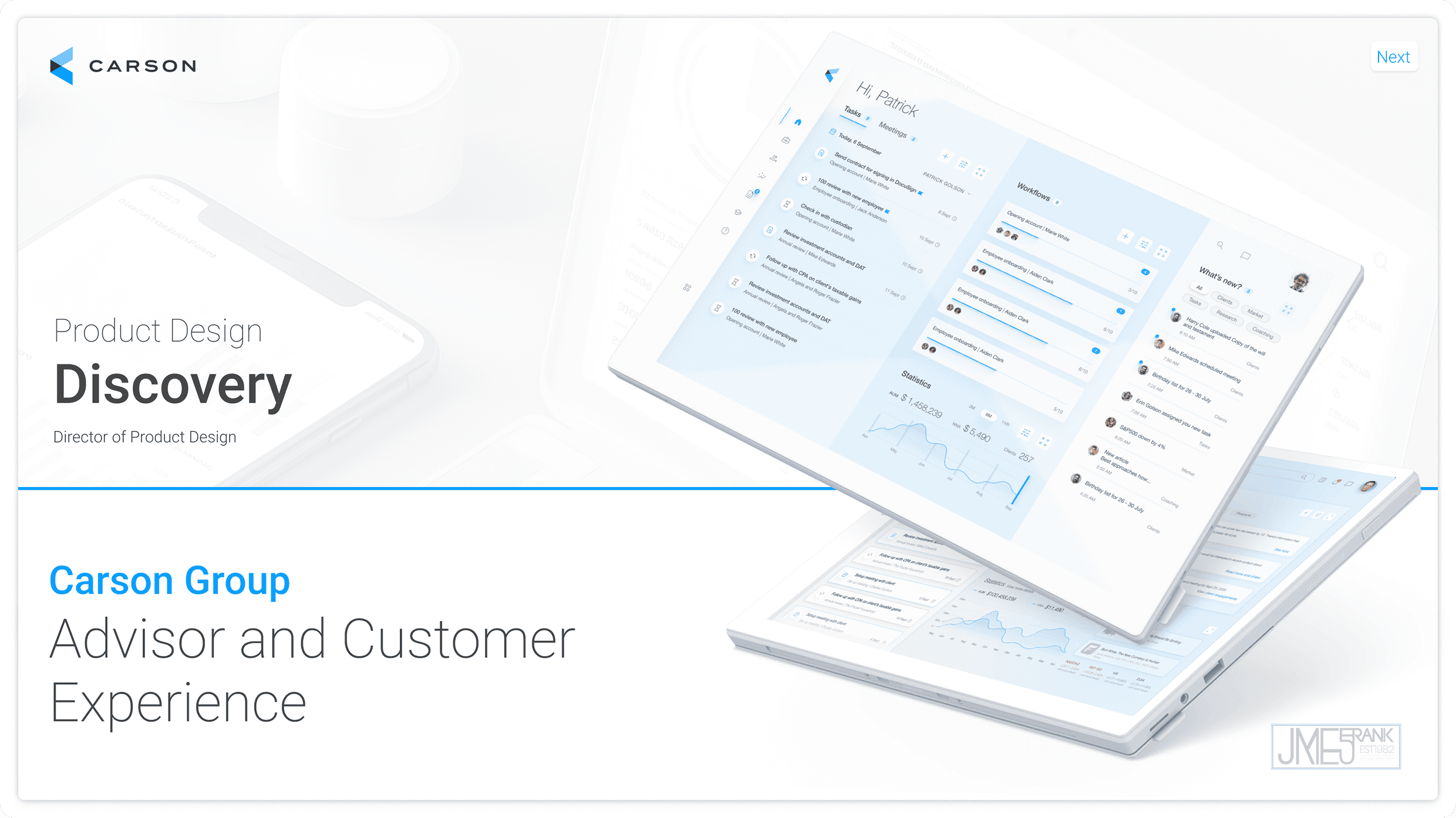
Carson Group aims to address inefficiencies caused by a fragmented software ecosystem by optimizing workflows and forming an in-house product team. Their objective is to create a unified software solution that caters to both advisors and clients, setting a new industry standard for digital innovation in financial services.
Carson Group aims to address inefficiencies caused by a fragmented software ecosystem by optimizing workflows and forming an in-house product team. Their objective is to create a unified software solution that caters to both advisors and clients, setting a new industry standard for digital innovation in financial services.
My Role
Director of Product Design
As Director of Product Design at Carson Group, I led the discovery effort for a unified advisor and client platform. I ran research with advisors and stakeholders, aligned goals across product, research, and line-of-business partners, and translated those insights into the vision and roadmap that set the foundation for a cohesive product experience.
Director of Product Design
As Director of Product Design at Carson Group, I led the discovery effort for a unified advisor and client platform. I ran research with advisors and stakeholders, aligned goals across product, research, and line-of-business partners, and translated those insights into the vision and roadmap that set the foundation for a cohesive product experience.
Director of Product Design
As Director of Product Design at Carson Group, I led the discovery effort for a unified advisor and client platform. I ran research with advisors and stakeholders, aligned goals across product, research, and line-of-business partners, and translated those insights into the vision and roadmap that set the foundation for a cohesive product experience.
Human Centered Design Approach
This effort followed a human-centered design approach carried out across two phases. The strategic discovery phase focused on understanding the problem deeply, moving through approach, discovery, and envisioning to establish direction, then concept, evaluation, and definition to shape and validate ideas against clear goals. The optimal delivery phase carried that vision forward, progressing through ideation, testing, and design, then build, measure, and define to develop and internally validate high-fidelity solutions. Together, the two phases formed a cohesive process, carrying the work from insight to a validated, build-ready direction.
Strategic Discovery Phase
Approach: The strategic discovery phase centered on thorough analysis, stakeholder consultation, and alignment on project goals, establishing a clear roadmap toward our desired outcomes.
Discover: Discovery involved in-depth research, data collection, and exploration to reveal essential insights, identify challenges, and pinpoint opportunities aligned with the project's objectives.
Envision: In the envision phase, we consolidated the insights gathered during discovery into a unified vision, defining desired outcomes, setting clear objectives, and shaping the strategy for the project's success.
Concept: The concept phase brought the team together for brainstorming and ideation sessions, generating creative ideas and concepts aligned with the project vision and objectives.
Evaluate: In the evaluate phase, the team critically analyzed the generated concepts, assessing their feasibility, effectiveness, and alignment with project goals, then refined them based on the feedback and insights gathered.
Define: The define phase distilled the gathered insights into clear project goals, scope, and success criteria, establishing a solid foundation for the subsequent development phases.
Optimal Delivery Phase Phase
Ideate: The ideate phase generated a diverse range of creative solutions to address identified challenges and opportunities, fostering innovation and out-of-the-box thinking.
Test: In the test phase, we validated proposed solutions through internal testing with stakeholders and advisors, using their feedback to iteratively refine concepts and ensure alignment with project objectives.
Design: The design phase transformed insights and ideas into tangible prototypes and concepts, providing a solid foundation for iterative development and refinement.
Build: The build phase focused on implementing and executing the refined designs and prototypes, developing them into functional, high-fidelity solutions ready for internal validation.
Measure: In the measure phase, we assessed solution performance through internal stakeholder testing, gathering feedback and tracking key indicators to guide iterative enhancements and inform future development.
Define: The define phase distilled the gathered insights into clear project goals, scope, and success criteria, establishing a solid foundation for the subsequent development phases.
Together, these phases carried the effort from broad ambition to a validated, build-ready solution. Strategic discovery grounded every decision in research, stakeholder alignment, and a clear vision, establishing the shared understanding and prioritized roadmap to move forward with confidence. The optimal delivery phase brought that vision to life through prototyping, internal validation, and iterative refinement. While the platform remained pre-launch, this work de-risked the path forward and equipped the team with a clear direction for continued development.
This effort followed a human-centered design approach carried out across two phases. The strategic discovery phase focused on understanding the problem deeply, moving through approach, discovery, and envisioning to establish direction, then concept, evaluation, and definition to shape and validate ideas against clear goals. The optimal delivery phase carried that vision forward, progressing through ideation, testing, and design, then build, measure, and define to develop and internally validate high-fidelity solutions. Together, the two phases formed a cohesive process, carrying the work from insight to a validated, build-ready direction.
Strategic Discovery Phase
Approach: The strategic discovery phase centered on thorough analysis, stakeholder consultation, and alignment on project goals, establishing a clear roadmap toward our desired outcomes.
Discover: Discovery involved in-depth research, data collection, and exploration to reveal essential insights, identify challenges, and pinpoint opportunities aligned with the project's objectives.
Envision: In the envision phase, we consolidated the insights gathered during discovery into a unified vision, defining desired outcomes, setting clear objectives, and shaping the strategy for the project's success.
Concept: The concept phase brought the team together for brainstorming and ideation sessions, generating creative ideas and concepts aligned with the project vision and objectives.
Evaluate: In the evaluate phase, the team critically analyzed the generated concepts, assessing their feasibility, effectiveness, and alignment with project goals, then refined them based on the feedback and insights gathered.
Define: The define phase distilled the gathered insights into clear project goals, scope, and success criteria, establishing a solid foundation for the subsequent development phases.
Optimal Delivery Phase Phase
Ideate: The ideate phase generated a diverse range of creative solutions to address identified challenges and opportunities, fostering innovation and out-of-the-box thinking.
Test: In the test phase, we validated proposed solutions through internal testing with stakeholders and advisors, using their feedback to iteratively refine concepts and ensure alignment with project objectives.
Design: The design phase transformed insights and ideas into tangible prototypes and concepts, providing a solid foundation for iterative development and refinement.
Build: The build phase focused on implementing and executing the refined designs and prototypes, developing them into functional, high-fidelity solutions ready for internal validation.
Measure: In the measure phase, we assessed solution performance through internal stakeholder testing, gathering feedback and tracking key indicators to guide iterative enhancements and inform future development.
Define: The define phase distilled the gathered insights into clear project goals, scope, and success criteria, establishing a solid foundation for the subsequent development phases.
Together, these phases carried the effort from broad ambition to a validated, build-ready solution. Strategic discovery grounded every decision in research, stakeholder alignment, and a clear vision, establishing the shared understanding and prioritized roadmap to move forward with confidence. The optimal delivery phase brought that vision to life through prototyping, internal validation, and iterative refinement. While the platform remained pre-launch, this work de-risked the path forward and equipped the team with a clear direction for continued development.
Desirability · Feasibility · Viability
Discover: Stakeholder workshops, interviews, surveys, competitive scan, journey maps.
Define: Surface friction (buried nav, unclear progress, complex redemption); prioritize by value + tech constraints.
Design: New IA, visual rewards dashboard, prototyped flows; iterative usability testing.
Deliver: Paired with dev/Epsilon; shipped pixel-perfect UI + annotated specs.
Success Measures (pre-launch)
With the platform still pre-launch, success was defined by discovery outcomes: alignment, clarity, and a validated vision.
Because this effort centered on discovery, success was measured by how well it de-risked the path forward and aligned the team on a shared vision.
Cross-functional alignment achieved. Brought leads, product owners, researchers, and line-of-business stakeholders into shared agreement on goals, scope, and success criteria.
Unified product vision established. Consolidated a fragmented software ecosystem into a single, agreed-upon vision and roadmap for the advisor and client experience.
Design system and standards created. Delivered a reusable design system and standards that gave the new in-house product team a consistent foundation to build from.
Validated concepts through advisor feedback. Prototyped flows tested and refined with advisors, with positive qualitative feedback on the platform vision and workflow improvements.
Prioritized opportunity backlog defined. Translated research into a ranked set of opportunities weighed by user value and technical feasibility, giving development a clear starting point.
De-risked the build. Discovery surfaced friction and constraints early, reducing potential downstream rework before engineering investment.
With the platform still pre-launch, success was defined by discovery outcomes: alignment, clarity, and a validated vision. Because this effort centered on discovery, success was measured by how well it de-risked the path forward and aligned the team on a shared vision.
Cross-functional alignment achieved. Brought leads, product owners, researchers, and line-of-business stakeholders into shared agreement on goals, scope, and success criteria.
Unified product vision established. Consolidated a fragmented software ecosystem into a single, agreed-upon vision and roadmap for the advisor and client experience.
Design system and standards created. Delivered a reusable design system and standards that gave the new in-house product team a consistent foundation to build from.
Validated concepts through advisor feedback. Prototyped flows tested and refined with advisors, with positive qualitative feedback on the platform vision and workflow improvements.
Prioritized opportunity backlog defined. Translated research into a ranked set of opportunities weighed by user value and technical feasibility, giving development a clear starting point.
De-risked the build. Discovery surfaced friction and constraints early, reducing potential downstream rework before engineering investment.
Lessons Learned & Solutions
Leading discovery on a platform that never reached launch surfaced valuable lessons, both about the work itself and the organizational conditions needed to carry a vision through to delivery.
Vision needs an execution engine behind it. Discovery produced strong alignment and a clear roadmap, but a newly formed in-house team was still building the muscle to move from validated concepts to shipped product. Opportunity: Establish delivery capacity and engineering commitment in parallel with discovery, so momentum carries forward rather than stalling at the handoff.
Internal validation is a strength, but it has limits. Testing with stakeholders and advisors produced fast, high-quality feedback and kept the work aligned. It could not fully stand in for real client usage. Opportunity: Pair internal validation with a small, structured pilot or beta to pressure-test assumptions against live behavior before committing to a full build.
Fragmented ecosystems resist quick consolidation. Unifying scattered tools into one experience was as much an organizational and political challenge as a design one. Opportunity: Invest early in stakeholder buy-in and a phased migration strategy, so consolidation feels like an evolution rather than a disruption to existing workflows.
A design system is only as durable as its ownership. The system created a strong foundation, but its long-term value depends on continued investment and governance after the initial build. Opportunity: Define clear ownership, contribution standards, and maintenance rhythms up front to keep the system alive as the team scales.
Continuity matters in long-horizon work. Ambitious platform efforts span longer than any single tenure, and knowledge can walk out the door with people. Opportunity: Document decisions, rationale, and research thoroughly so the work remains legible and actionable for whoever carries it forward.
Leading discovery on a platform that never reached launch surfaced valuable lessons, both about the work itself and the organizational conditions needed to carry a vision through to delivery.
Vision needs an execution engine behind it. Discovery produced strong alignment and a clear roadmap, but a newly formed in-house team was still building the muscle to move from validated concepts to shipped product. Opportunity: Establish delivery capacity and engineering commitment in parallel with discovery, so momentum carries forward rather than stalling at the handoff.
Internal validation is a strength, but it has limits. Testing with stakeholders and advisors produced fast, high-quality feedback and kept the work aligned. It could not fully stand in for real client usage. Opportunity: Pair internal validation with a small, structured pilot or beta to pressure-test assumptions against live behavior before committing to a full build.
Fragmented ecosystems resist quick consolidation. Unifying scattered tools into one experience was as much an organizational and political challenge as a design one. Opportunity: Invest early in stakeholder buy-in and a phased migration strategy, so consolidation feels like an evolution rather than a disruption to existing workflows.
A design system is only as durable as its ownership. The system created a strong foundation, but its long-term value depends on continued investment and governance after the initial build. Opportunity: Define clear ownership, contribution standards, and maintenance rhythms up front to keep the system alive as the team scales.
Continuity matters in long-horizon work. Ambitious platform efforts span longer than any single tenure, and knowledge can walk out the door with people. Opportunity: Document decisions, rationale, and research thoroughly so the work remains legible and actionable for whoever carries it forward.
Reflection
Leading design discovery at Carson Group was one of the more formative chapters of my career, precisely because it didn't end with a launch. It taught me that the value of the work isn't only in what ships, but in the clarity, alignment, and foundation you leave behind.
I'm proud of what this effort built: a unified vision where there had been fragmentation, a shared language across teams that rarely spoke the same one, and a design system and body of research that gave a young in-house team something real to stand on. Watching stakeholders and advisors engage with the prototypes, seeing them recognize their own problems in the work, was a reminder of why I do this.
I also carry the honest truth that it never crossed the finish line before I moved on. That's part of building ambitious things inside real organizations, where vision often outpaces the capacity to deliver it. If anything, it deepened my respect for the distance between a validated concept and a shipped product, and my commitment to closing that gap.
Most of all, this work reaffirmed where I want to be: close to the craft, deep in the problem, shaping the vision and the details alongside the people who bring it to life. It's the kind of work I want to keep doing.